
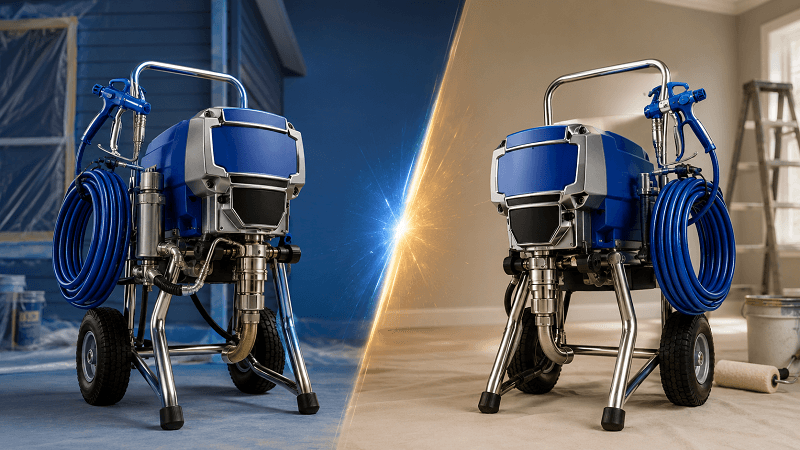
Every week, I talk to homeowners who bought the wrong Graco sprayer. Sometimes they bought the X5 when they needed the X7 — and spent an entire exterior repaint weekend fighting a machine that was running at its limit. More often, they bought the X7 when the X5 would have done the job fine — and spent $80 more than they needed to.
Both outcomes are avoidable. The Graco Magnum X5 and X7 are good machines. Neither is better in any absolute sense. They are designed for different use cases, and the majority of buying mistakes happen because homeowners focus on the wrong things when comparing them.
As an authorized Graco dealer who has supplied both machines — and the OEM parts that keep them running — for years, I want to give you the honest, plain-English comparison that cuts through the spec-sheet noise. By the end of this guide, you will know exactly which machine fits your projects, and why. You can also see the full Graco X5 vs X7 comparison on our site if you’d like a quick summary version.
The #1 Mistake Homeowners Make When Comparing These Two Sprayers
The most common mistake is comparing specifications without understanding what those specifications mean in practice. Most people look at the price difference ($80) and the motor size difference (½ HP vs ⅝ HP) and assume the X7 must be substantially more powerful and capable. It is not — at least not in the ways most homeowners think.
On the most common homeowner job — painting interior walls and ceilings with standard latex — the X5 and X7 produce virtually identical results. Same fan quality. Same pressure consistency. Same finish. The X7’s stronger motor and higher flow rate don’t produce a noticeably better interior finish; they produce a faster exterior finish on thicker materials.
The second most common mistake is the opposite: assuming the X5 can handle every job the X7 can, just a little slower. It cannot. The X5’s .015” maximum tip size is a hard constraint that causes real problems on specific materials — thick exterior latex, high-build primers, and anything that specifies a .017” or larger tip. When the X5 is pushed onto those materials, it struggles: pressure fluctuates, the fan becomes inconsistent, and the pump wears faster than it should.
The right comparison is not “which is better.” The right comparison is: which machine fits the jobs I actually have?
The Four Differences That Actually Change Outcomes
Ignore the marketing language. Here are the four differences between the X5 and X7 that actually matter in real use, and what each one means for a homeowner.
Difference #1: Maximum Tip Size — .015” vs .017”
This is the most important difference, and the least discussed. Every spray tip has an orifice size — the diameter of the hole that paint passes through. Larger orifice = more paint per stroke = the machine handles thicker materials. The X5’s maximum is .015” (a 515 RAC X tip). The X7’s maximum is .017” (a 517 RAC X tip).
Why does a .002” difference matter? Because most premium exterior latex paints are formulated for .015”–.019” tips. Running a .015” tip on thick exterior paint forces the X5’s pump to work at the edge of its capability — continuously. Pressure fluctuates, the fan narrows, and the motor cycles faster than it should. The X7’s .017” tip handles those same materials without straining.
For interior work with standard latex flat or eggshell — which is designed for .013”–.017” tips — the X5’s 515 tip is perfectly adequate. The difference is only felt when you step outside to heavier materials.
⚠️ The Tip Size Test: Does This Apply to You?
If the paint you’re planning to use says ‘recommended tip .017” or larger’ on the label — or if you’re spraying any exterior latex, deck coating, or primer described as ‘high build’ — the X7 is the right machine. If you’re spraying standard interior latex flat or eggshell, the X5 is fine.
Difference #2: Flow Rate — 0.27 vs 0.31 GPM
The X7 moves 0.31 gallons of paint per minute. The X5 moves 0.27. That’s a 15% increase in output. On a 400 square foot interior room, the time difference is barely noticeable — maybe five minutes. On a full house exterior repaint — 2,000+ square feet over two coats — that 15% adds up to 30–45 minutes of spray time saved per coat.
For a single interior bedroom repaint, this difference is irrelevant. For a full exterior house with two coats, it’s the difference between finishing comfortably and watching daylight run out on Sunday afternoon.
Difference #3: Cart vs Stand — Mobility on Large Jobs
The X5 sits on a fixed stand and weighs 13 pounds. You carry it where you need it and set it down. The X7 sits on a wheeled cart with pail hooks and weighs 19 pounds. You roll both the machine and your paint bucket together as you move.
For a single room or a fence in a fixed location, the stand is simpler and lighter. For exterior work — where you move around the perimeter of a house, relocating every 10–15 minutes — rolling the machine instead of carrying it is a genuine quality-of-life improvement. The X7’s pail hooks also let you hang the bucket at working height rather than setting it on the ground, which helps as the paint level drops.
Difference #4: Maximum Hose Length — 75 ft vs 100 ft
The X5 supports up to 75 feet of total hose. The X7 supports up to 100 feet. For most one-story exterior work, 75 feet is more than enough. For a two-story home where you want to leave the machine on the ground and reach the peak with hose plus an extension wand, 100 feet of capacity makes that possible. For single-story or interior work, this difference is irrelevant.
Side-by-Side Specifications — Everything That’s Different
| Specification | Magnum X5 (262800) | Magnum X7 (262805) |
| Motor Power | ½ HP | ⅝ HP |
| Max Flow Rate | 0.27 GPM | 0.31 GPM |
| Max Pressure | 3,000 PSI | 3,000 PSI |
| Max Tip Size | .015″ orifice | .017″ orifice |
| Included Hose | 25 ft DuraFlex | 25 ft DuraFlex |
| Max Hose Length | 75 ft | 100 ft |
| Weight | 13 lbs | 19 lbs |
| Configuration | Fixed stand | Wheeled cart + pail hooks |
| Annual Use Rating | 125 gal/year | 125 gal/year |
| PushPrime | ✓ Yes | ✓ Yes |
| PowerFlush Adapter | ✓ Yes | ✓ Yes |
| Suction Tube | Flexible — 1 or 5 gal | Flexible — 1 or 5 gal |
| Included Tip | RAC X 515 (.015″) | RAC X 515 (.015″) |
| Warranty | 1 year | 1 year |
| Approx. Price | ~$299 | ~$379 |
📌 What’s Identical Between the Two Machines
Both use the same stainless steel piston pump design. Both spray unthinned latex. Both have PushPrime and PowerFlush. Both carry a one-year warranty. Both include the SG2 metal spray gun and a RAC X 515 tip. The X7 is not a fu
ndamentally different machine — it is an incremental upgrade in specific areas.
The Honest Answer for Seven Common Homeowner Projects
Instead of abstract comparisons, here is a direct verdict for the most common homeowner painting projects:
Project 1: Repainting a bedroom or living room (interior, standard latex)
Which machine: X5. Standard interior latex flat, eggshell, or satin through a 515 tip works identically on both machines. The X5 is lighter to carry between rooms and costs $80 less. There is no scenario in this project type where the X7 produces better results.
Project 2: Painting all interior rooms of a house (full interior repaint)
Which machine: X5 or X7 (depends on paint). For standard flat or eggshell latex — X5 is fine. If you’re using premium washable paint or a thicker formulation that specifies .017” — X7 handles it more cleanly. Check your paint label tip recommendation before deciding.
Project 3: Exterior house repaint — siding, soffit, fascia (one or two story)
Which machine: X7. Exterior latex almost always runs heavier than interior. The X7’s .017” tip handles it without straining the pump. On a two-story home, the X7’s 100-foot hose capacity lets you spray the upper sections from the ladder with the machine on the ground. The cart also makes moving around the perimeter substantially easier.
Project 4: Painting a fence (150–400 linear feet, stain or latex)
Which machine: X5. Fence stains are thin materials that flow easily through a .015” tip. The X5’s flow rate is more than sufficient, and its lighter weight makes repositioning along the fence line easier. The X7’s cart provides no real advantage on fence work — you’re moving constantly and the stand design is actually more portable in this context.
Project 5: Painting a deck (solid or semi-transparent coating)
Which machine: X5 for semi-transparent, X7 for solid deck coatings. Semi-transparent deck stains are thin — X5 handles them perfectly. Solid deck coatings are heavier and often specify .015”–.017” tips. If your solid deck coating label says .017” minimum, use the X7.
Project 6: Painting a shed, garage, or outbuilding
Which machine: X5. Most outbuilding projects use standard exterior latex or solid stain — materials the X5 handles adequately. The job is typically small enough that the X5’s 0.27 GPM flow rate is not a limiting factor. The lighter machine is easier to position and move around a small structure.
Project 7: Full weekend painting renovation (interior + exterior, multiple surfaces)
Which machine: X7. A full renovation weekend means multiple material types including exterior coatings, more than 1,000 square feet of total surface area, and constant machine repositioning. The X7’s extra flow rate saves time across the full day. The cart handles the logistics. The .017” tip covers all material types without fighting the pump.
Four Things Homeowners Get Wrong When Buying — And How to Avoid Them
Mistake #1: Buying the X5 for an Exterior Repaint With Premium Latex
This is the most common expensive mistake. A homeowner buys the X5 for a full exterior house repaint, loads premium exterior latex, and spends the weekend fighting inconsistent pressure and a fan that won’t stay stable. They blame the machine. The machine isn’t failing — it’s being asked to run thick exterior latex through a .015” tip at maximum capacity, continuously. The fix would have been either choosing the X7 or buying thinner-formula exterior paint. The X5 can handle exterior latex — but it needs to be the right formulation.
Before you buy: Read the tip size recommendation on the back of your paint can. If it says ‘minimum .017” tip’, buy the X7. If it says .013”–.015”, the X5 is fine.
Mistake #2: Buying the X7 for an Interior-Only Job and Never Using the Advantages
The second most common mistake. A homeowner buying the X7 for an interior bedroom repaint pays $80 more for a heavier machine, a wheeled cart they don’t need indoors, and a .017” tip capability they’ll never use on standard interior latex. The result is identical to the X5 on this job. If your only projects are interior rooms with standard latex, save the $80.
Mistake #3: Ignoring the Annual Usage Rating
Both machines are rated for 125 gallons per year. Most homeowners don’t know this rating exists and don’t track their usage. A homeowner doing a full exterior repaint (40–60 gallons) plus two interior rooms (10–15 gallons) in a season is using the machine well within its rating. A homeowner flipping a rental property and running 200+ gallons through it in one summer is exceeding it — which accelerates pump wear. If your annual usage will consistently exceed 125 gallons, neither the X5 nor X7 is the right machine. You want a contractor-class machine.
Mistake #4: Not Stocking the Repair Parts Before They’re Needed
The most expensive mistake doesn’t happen at purchase — it happens 18 months later on a Saturday morning when the machine won’t prime and you have a half-painted exterior wall waiting. Both the X5 and X7 have wear components that follow a predictable service schedule. A $22 inlet valve kit and a $65 pump repair kit sitting on the shelf eliminate the mid-project emergency. Not having them means ordering, waiting, and losing your weekend.
The Parts to Stock for Whichever Machine You Choose
Both machines share most of the same OEM replacement parts. Every part listed below is available with same-day shipping on qualifying orders before 1pm CST from our Houston facility.
Parts Both Machines Share
- 17V781 — Magnum Pump Repair Kit: The complete pump rebuild kit for both machines. Includes pressure control assembly, outlet valve, inlet valve, drain valve, and PushPrime kit. Order this before your machine starts showing wear — not after. Cost: ~$65. Rebuild time: 35 minutes.
- 17J876 — Inlet Housing Kit: Ball, spring, and seat. The most common cause of ‘won’t prime after storage’ on both machines. Replace at the same time as the pump kit on any machine with 100+ gallons. Cost: ~$22.
- 17J880 — Outlet Valve Kit: When the machine primes but won’t hold pressure at the gun — this is the fix. Accessible via the easy-access door on both machines. Cost: ~$18.
- RAC X 515 SwitchTip: The factory-included tip on both machines. Replace when the fan collapses more than 25% from its rated width. Keep a spare in the kit at all times.
- Gun handle filters: Keep 15+ on hand. Replace every bucket switch during production. They cost under $2 each and prevent 80% of mid-job pressure drops that get blamed on the pump.
- Pump Armor (17S980): Run through both machines after every job before storage. Non-negotiable maintenance step that prevents the inlet ball from bonding to its seat during storage.
X7-Specific Parts
- RAC X 517 SwitchTip: The tip that takes full advantage of the X7’s .017” capability. For exterior latex and thicker materials, this is the correct tip for the X7. Keep one alongside your 515.
- 24V075 — Suction Tube Kit (cart model): The X7’s cart-specific suction tube assembly. Different from the X5 stand model (24V074). Confirm via parts diagram if replacing.
💡 The Most Important Maintenance Habit for Both Machines
Run Pump Armor through the machine after every job, every time, before storing. Latex paint left in the pump dries on the inlet valve ball and seat. On the next startup, the ball doesn’t move freely and the machine won’t prime. Every won’t-prime call we get from homeowners traces back to storage without Pump Armor. It takes 30 seconds and prevents the problem completely.
The Two-Question Decision Guide
If every comparison in this article still leaves you unsure, answer these two questions:
- What materials are you spraying? Check the tip recommendation on the back of the paint or stain you plan to use. If the label says .017” minimum tip — buy the X7. If it says .015” or smaller — the X5 is fine.
- What is the total surface area of your project? Under 1,500 square feet of interior surface with standard latex: X5 is fully capable. Full exterior house repaint, or any project over 1,500 square feet with heavier exterior materials: the X7’s flow rate and tip flexibility justify the $80 premium.
If your answers to both questions point to the X5 — buy the X5. It is an excellent machine for the projects it was designed for. If either answer points to the X7 — buy the X7. The $80 difference is not the deciding factor. Getting the right machine for your actual project is.
The Verdict
The Graco X5 and X7 are both well-built machines at their price points. Neither is inherently superior. The X5 is the better choice for interior work, staining projects, small to medium exterior jobs with standard latex, and anyone who values lighter weight and lower cost. The X7 is the better choice for full exterior repaints with premium latex, two-story homes where hose reach matters, and anyone who will regularly use the machine across larger surface areas.
The mistake is not buying one over the other. The mistake is buying either one without checking whether your specific paint and project fit the machine’s actual specifications — especially the tip size ceiling that almost no one reads about until their first bad spray day.
Check your paint label. Measure your project. Then choose accordingly. Both machines have a complete OEM parts ecosystem so they can be serviced and kept running for years — which is what actually determines long-term value in any sprayer. You can browse Graco X5 vs X7 parts and specifications on our site, or call us at 713-931-4102 if you’d like a recommendation based on your specific project.