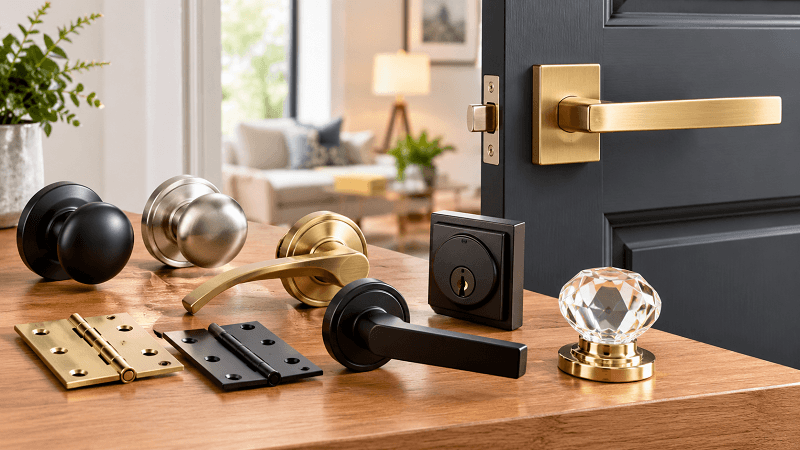
In most renovation budgets, doors get treated as a line item to be settled quickly. Pick a slab, pick a handle, move on to the things people will actually notice. It is an understandable instinct and a costly one, because door hardware is among the few elements in a home that every occupant touches several times a day, every day, for decades.
Worse, the hardware decision is not really about the handle at all. It is about the mechanism, and mechanism is the one thing that becomes expensive to change once the walls are closed up.
Start with how the door needs to move
Before considering finishes, work out what the opening actually has to do. A standard hinged door needs a clear arc roughly equal to its own width. In a generous hallway that costs nothing. In a small bathroom, a galley kitchen, or a bedroom where a door swing collides with a wardrobe, that arc is often the reason the room feels cramped.
There are now several ways around this, and they are not all sliding doors.
Rototranslating systems, sometimes described as swing and slide, combine a rotating and a sliding movement so the door tucks back on itself as it opens. The result is roughly half the swing footprint of a conventional hinged door, with no track on the floor and no need for masonry work or a wall cavity. The Italian made Ergon Living range is the best known example of this approach, and Milcasa’s swinging door hardware collection covers the S40 and the slimmer T.E. variants. These handle doors up to seventy kilograms, which comfortably includes solid core slabs.
For genuinely tight openings, fold
Some openings do not have room for any swing at all. Laundry closets are the classic case, where a traditional bifold consumes several inches on each side and blocks access to the appliances behind it.
Folding hardware solves this by hinging the leaves against each other rather than against the frame. A Compack 180 folding door system opens the full width of the aperture, which matters when the thing behind it is a front loading washer with a door that needs to open fully. There is a ninety degree version for situations where the full fold is unnecessary. Precut panels and matching jambs are available for both, which removes the most error prone part of installation.
Concealed sliding for a clean wall
Where a wall cavity exists or a surface mounted track is acceptable, concealed sliding systems give the most minimal result. Wall mounted systems hide the track entirely and produce the impression of a door floating along the wall. Look for fluid dampers and anti bounce mechanisms in the specification. These are what separate a door that glides and stops softly from one that rattles into its end stop and slowly loosens over a few years.
The details you feel
Once the mechanism is settled, the smaller choices carry the character. Concealed hinges with flush covers eliminate the visual interruption of standard butt hinges. Magnetic latches close without the mechanical clack of a traditional catch. Recessed and magnetic edge pulls keep a sliding door flush. Handles in matched finishes tie the whole assembly together.
None of these are structural decisions, but collectively they are what makes a door feel considered rather than assembled.
Practical checks before you order
Four things worth confirming for any system you are considering. First, the maximum door weight and dimensions, since heavy solid core and glass doors rule out some hardware immediately. Second, minimum door thickness, which is frequently thirty millimetres or more. Third, whether precut panels and prepared jambs are offered, because routing hardware pockets accurately in a door you have already bought is a specialist job. Fourth, the quality of the installation documentation, and whether jigs or templates are available.
That last point is worth being blunt about. Precision European hardware rewards precise installation. Buying the system with its matched panels and casings costs more upfront and usually saves money once labour is counted.
Where to look
Milcasa curates Italian made door systems from Ergon, Compack, and Magic for residential and commercial projects across the United States, with free shipping and most orders dispatched within a couple of days. If you are looking for the best quality door hardware for a renovation or a new build, browse the collections or contact the team to talk through which mechanism suits your opening. Getting this right at the specification stage is far cheaper than revisiting it later.